Is ModelDoc2::LockModel supposed to increase performance? I’m running some benchmarks, and I am noticing it is doing the opposite.
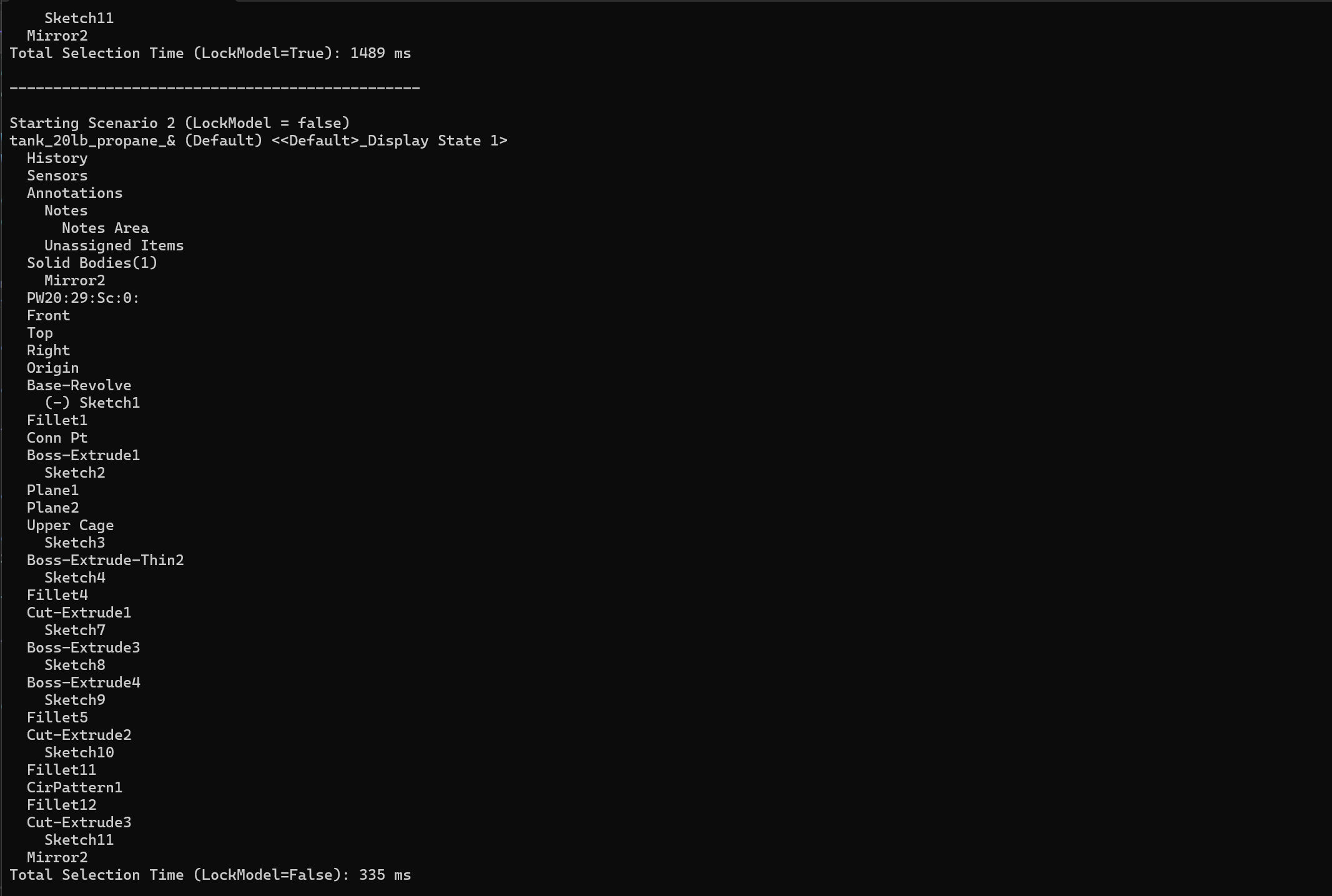
  public class Example
  {
      public static void Run()
      {
          var solidworksManager = new SOLIDWORKSInstanceManager();
          var swApp = solidworksManager.GetNewInstance("", SOLIDWORKSInstanceManager.Year_e.Latest, 160);
          swApp.Visible = true;

          var currentLocation = (new FileInfo(typeof(Example).Assembly.Location)).Directory;
          var testFile = currentLocation.GetFiles()
              .FirstOrDefault(x => x.Name.Equals("tank_20lb_propane_&.SLDPRT", StringComparison.OrdinalIgnoreCase));

          if (testFile == null)
              throw new FileNotFoundException("Could not find 'tank_20lb_propane_&.SLDPRT' in the current directory.");

          string filePath = testFile.FullName;

          // Open the file
          int errors = 0, warnings = 0;
          var swModel = swApp.OpenDoc6(filePath,
                                       (int)swDocumentTypes_e.swDocPART,
                                       (int)swOpenDocOptions_e.swOpenDocOptions_Silent,
                                       "", ref errors, ref warnings);

          if (swModel == null)
              throw new InvalidOperationException("Failed to open the document.");

          // Scenario 1: LockModel = true
          Console.WriteLine("Starting Scenario 1 (LockModel = true)");
          MeasureSelectionTime(swModel, true);


          swModel.ClearSelection();

          Console.WriteLine("\n-----------------------------------------------\n");

          // Scenario 2: LockModel = false
          Console.WriteLine("Starting Scenario 2 (LockModel = false)");
          MeasureSelectionTime(swModel, false);

          swApp.CloseDoc(swModel.GetTitle());
          swApp.ExitApp();

          Console.WriteLine("\nPress any key to exit...");
          Console.ReadKey();
      }

      private static void MeasureSelectionTime(ModelDoc2 swModel, bool lockModel)
      {
          var swFeature = (Feature)swModel.FirstFeature();

          var ModelView = swModel.ActiveView as ModelView;

          if (lockModel)
              swModel.Lock();

          var stopwatch = System.Diagnostics.Stopwatch.StartNew();

          var rootItem = swModel.FeatureManager.GetFeatureTreeRootItem2((int)swFeatMgrPane_e.swFeatMgrPaneBottom);
          TraverseTreeItems(rootItem);

          stopwatch.Stop();

          if (lockModel)
              swModel.UnLock();

          Console.WriteLine($"Total Selection Time (LockModel={lockModel}): {stopwatch.ElapsedMilliseconds} ms");
      }


      public static void PrintComponentsFlat(ModelDoc2 swModel)
      {
          Console.WriteLine("Method 1: Flat List using GetComponents");
          var swAssembly = swModel as AssemblyDoc;

          if (swAssembly == null)
              return;
          var comps = swAssembly.GetComponents(false) as object[];
          foreach (Component2 comp in comps)
              Console.WriteLine(comp.Name2);
      }
      // Method 2: Recursive Hierarchical Traversal using GetFeatureTreeRootItem
      public static void TraverseTreeItems(TreeControlItem item, string indent = "")
      {
          while (item != null)
          {
              Console.WriteLine($"{indent}{item.Text}");

              var child = item.GetFirstChild();
              if (child != null)
                  TraverseTreeItems(child, indent + "  ");

              item = item.GetNext();
          }
      }


      static void TraverseFeatureForComponents(Feature swFeature, Action<Component2> performAction)
      {
          var swSubFeature = default(Feature);

          var swComponent = swFeature.GetSpecificFeature2() as Component2;
          if (swComponent != null)
          {
              performAction(swComponent);

              swSubFeature = swComponent.FirstFeature();
              while (swSubFeature != null)
              {
                  TraverseFeatureForComponents(swSubFeature, performAction);
                  swSubFeature = swSubFeature.GetNextFeature() as Feature;
              }
          }


      }

  }
To clone repo here: SW_API_Tips_Tricks/LockModel/LockModel at master · BlueByteSystemsInc/SW_API_Tips_Tricks · GitHub
Yup it was out of process
– AmenJlili